Commonly known as Sagarmatha in Nepali, or “Goddess of the Sky,” and Chomolungma in Tibetan, or “Goddess Mother of the World,” this massive peak draws adventurers, scientists, and visitors from the remotest corners of the globe. From its breathtaking ridges to inhospitable weather and cultural significance, Everest is simply a majestic mountain.
Location and Geography
Mount Everest is located in the Great Himalayas of southern Asia at extremely exact coordinates. It is at 27°59′ N and 86°56′ E. Its base extends through Nepal and Tibet and creates a natural border between these two nations.
Everest Region is encircled by a long massif of mountains that also comprises other well-known peaks such as Lhotse (8,516 meters), Nuptse (7,861 meters), Khumbutse (6,665 meters), and Changtse (7,560 meters).
The more popular southern route via Nepal is famous for the Khumbu Icefall, a difficult and savage part of tumbling ice, while the northern route via Tibet is less traveled and is technically difficult.
Geological History and Composition
The Indian Plate collided with the Eurasian Plate 50 to 60 million years ago, thrusting the Himalayas upward. The Great Himalayas and Everest began forming together between 25 and 30 million years ago. The mountain is continuing to grow at a rate of about 44 millimeters annually due to the tectonic forces still at play.
Everest’s geology is complex and layered. Its lower altitudes are made up of metamorphic rocks such as gneisses and schists, topped by igneous granites. Its uppermost strata are made up of marine sedimentary rocks, a vestige of the old Tethys Sea. The Yellow Band, a huge limestone layer, forms the topmost layer of the Everest.
Shape and Key Features
Everest is a three-sided pyramid with tall and steep ridges. It’s the North Face that looms over Tibet, between the North Ridge and West Ridge, with dangerous couloirs such as the Great and Hornbein couloirs.
The Southwest Face, on Nepal’s side, has the notorious South Col and Khumbu Icefall, a particularly deadly feature to pass through in mountaineering. The East Face, or Kangshung Face, is distant, rarely climbed, and extremely challenging due to avalanches and icefalls.
The summit is a snow summit, with snowfall of 1.5 to 6 meters annually. The air on the summit has only some three-thirds of sea-level oxygen, so the summit is a region of harsh survival for a human.
Climate and Extreme Conditions
The weather on the Everest summit is notoriously extreme. Its summer temperature at the summit is typically −2°F (−19°C), and in winter it is as low as −33°F (−36°C) and even −76°F (−60°C) at times. Its winds are typically in excess of 100 miles per hour (160 km/h), and it often faces unpredictable storms.
The summit is lower than the jet stream, and climbers suffer extreme atmospheric conditions. Snow is the dominant type of precipitation, and frostbite and oxygen depletion are constant threats to any human who attempts to scale the summit.
Glaciers and Drainage
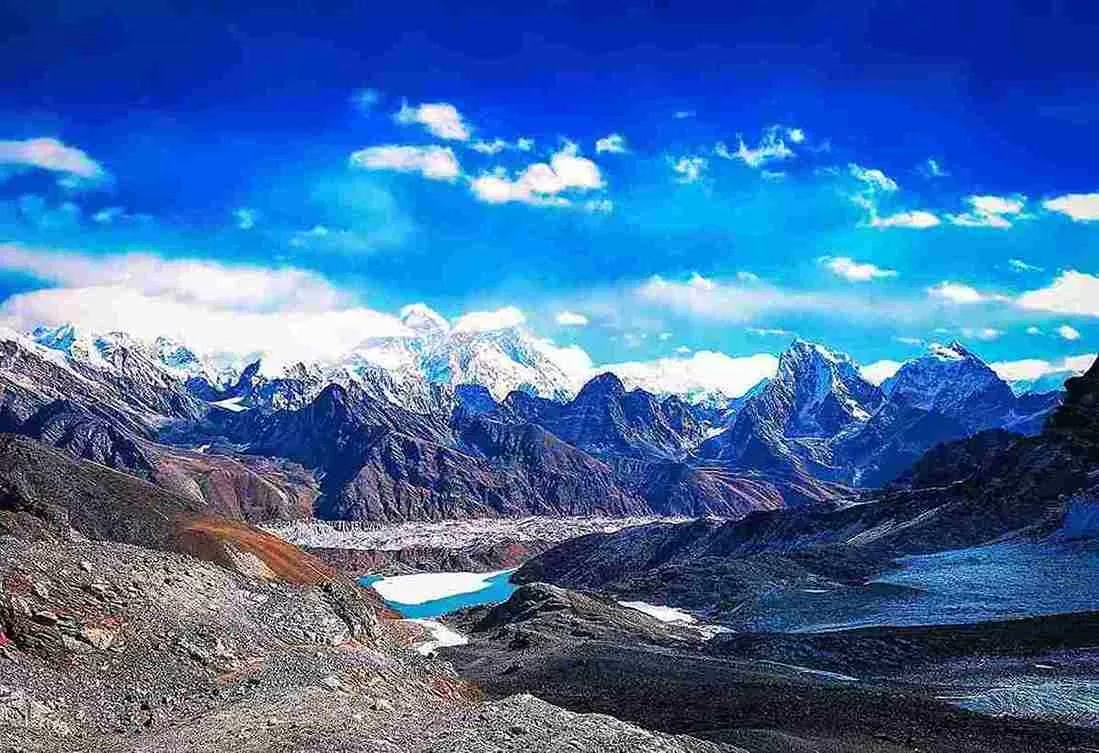
Everest’s faces are strongly glaciated. A few significant glaciers include the Khumbu Glacier on the south side, the Rongbuk Glacier on the north side, and the Kangshung Glacier on the east side.
These feed rivers like Nepal’s Dudh Kosi and Tibet’s Arun River. Glacial erosion shapes valleys day by day and poses a challenge for mountaineers to pass through the terrain. However, global warming is accelerating the melting of glaciers, which is not only an environmental risk but also a safety risk to the locals and mountaineers.
Cultural Significance
The surrounding communities contribute to profound religious and cultural significance. Sherpas, who inhabit the Khumbu valley, consider the mountain sacred. Buddhist monasteries stud the base, and prayer flags flutter further up in high camps seeking divine favor for climbers.
Divine beings, demons, even the mythical Yeti, have been mythologized here for centuries. Sherpas have succeeded in retaining deep respect for the mountain and their livelihood, with the addition of climbers and tourists.
Historic Climbing Records
The first successful ascent was made by Sir Edmund Hillary from New Zealand and Tenzing Norgay Sherpa from Nepal on 29th May 1953. Junko Tabei from Japan was the first woman to summit in 1975.
Jordan Romero from America, who was just 13 when he summited in 2010, is the youngest person to ascend the Everest, and Yuichiro Miura from Japan, who reached the summit at 80 years young in 2013, is the oldest. Sherpas feature heavily in the record books, and Kami Rita Sherpa has a staggering 30 ascents to his name to date.
Interesting Facts About Mount Everest
- Many Names of Mount Everest: Locals call it Sagarmatha (“Goddess of the Sky”) in Nepali and Chomolungma (“Goddess Mother of the World”) in Tibetan. It was officially named after Sir George Everest.
- Most Ascents: Kami Rita Sherpa ascended Everest 30 times till 2024.
- Oldest & Youngest Climbers: Jordan Romero from the USA ascended at the age of 13, Yuichiro Miura from Japan reached the summit at age 80.
- First Female Summit: Junko Tabei from Japan in 1975 became the first woman to summit Everest.
- Severe Weather: The temperature at the summit drops to −76°F (−60°C) with winds over 100 mph.
- Air Oxygenation: The breathable air at the summit has oxygen with only one-third the oxygen levels at sea level.
- Everest Height: The mountain increases in height by some 44 millimeters every year due to tectonic movement.
- Marriage on Everest: A Nepali couple were married at the summit in 2005; a Californian couple subsequently had a wedding at base camp.
- Height Disputes: Height has been officially re-measured numerous times; Nepal and China together agreed on 8,848.86 meters (29,031.69 ft) in 2020.
- Glaciers: Everest is blanketed by glaciers, including the Khumbu Glacier (south) and Rongbuk Glacier (north).
- Perilous Routes: 18 routes to the summit have been charted; the most coveted among them being South Col (Nepal) and North Col (China).
- Risk Sports: Everest has witnessed record-breaking in skiing, snowboarding, hang-gliding, and BASE jumping.
- Death Zone: Only for 48 hours continuously can the climbers spend in the death zone above 8,000 meters.
- Bodies on the Mountain: Over 200 bodies are present on Everest, incapacitated by freezing temperatures.
- Biodiversity: Despite the harsh conditions, there are moss, insects like the black jumping spider, and birds like the bar-headed goose that call Everest home.
- Traffic Jam: Climbing season creates jams near the Hillary Step and summit ridges when multiple climbers ascend the summit simultaneously.
Conclusion
Mount Everest is an extreme mountain, geologically, culturally, and climatically. Its mighty heights, unpredictable weather, and record have made it a deadly mountain.
While thousands ascend it each year, the mountain serves to remind us that greed must always be accompanied by a sense of wonder at nature. Adventure makes our pulses pound, but Everest is an emblem of survival, of strength, and of the tremendous power of our planet.







Comments [0]
Add CommentNo Comments Found